LetsVPN marketed itself as the VPN that “always connects”, aimed squarely at users in restrictive environments like China – until 28 April 2026, when it terminated its mainland China service and its CEO later admitted that promise had been overstated. This review looks at what the product actually delivered, through 100 real App Store and Google Play reviews, and at what is left of it now.
LetsVPN (Kuailian VPN) no longer works in mainland China. The company ended its mainland China service on 28 April 2026 and its CEO has confirmed it cannot serve mainland users any more. The VPN links on this site are the alternatives we recommend instead. Read the full timeline and sources →
LetsVPN publishes no pricing anywhere on its website – the /pricing URL returns a 404. New users get a 72-hour free trial and only see costs after signing up. Several reviewers reported surprise at the post-trial price, making it hard to compare before committing.
Two screenshots of the official LetsVPN marketing site, captured on 2026-09-24. There is deliberately no pricing screenshot: LetsVPN publishes no public pricing page at all – letsvpn.world/pricing returns a 404 and no price appears anywhere on the marketing site, because prices sit behind login and in-app purchase. That absence is exactly the transparency problem discussed above, and these captures document it.
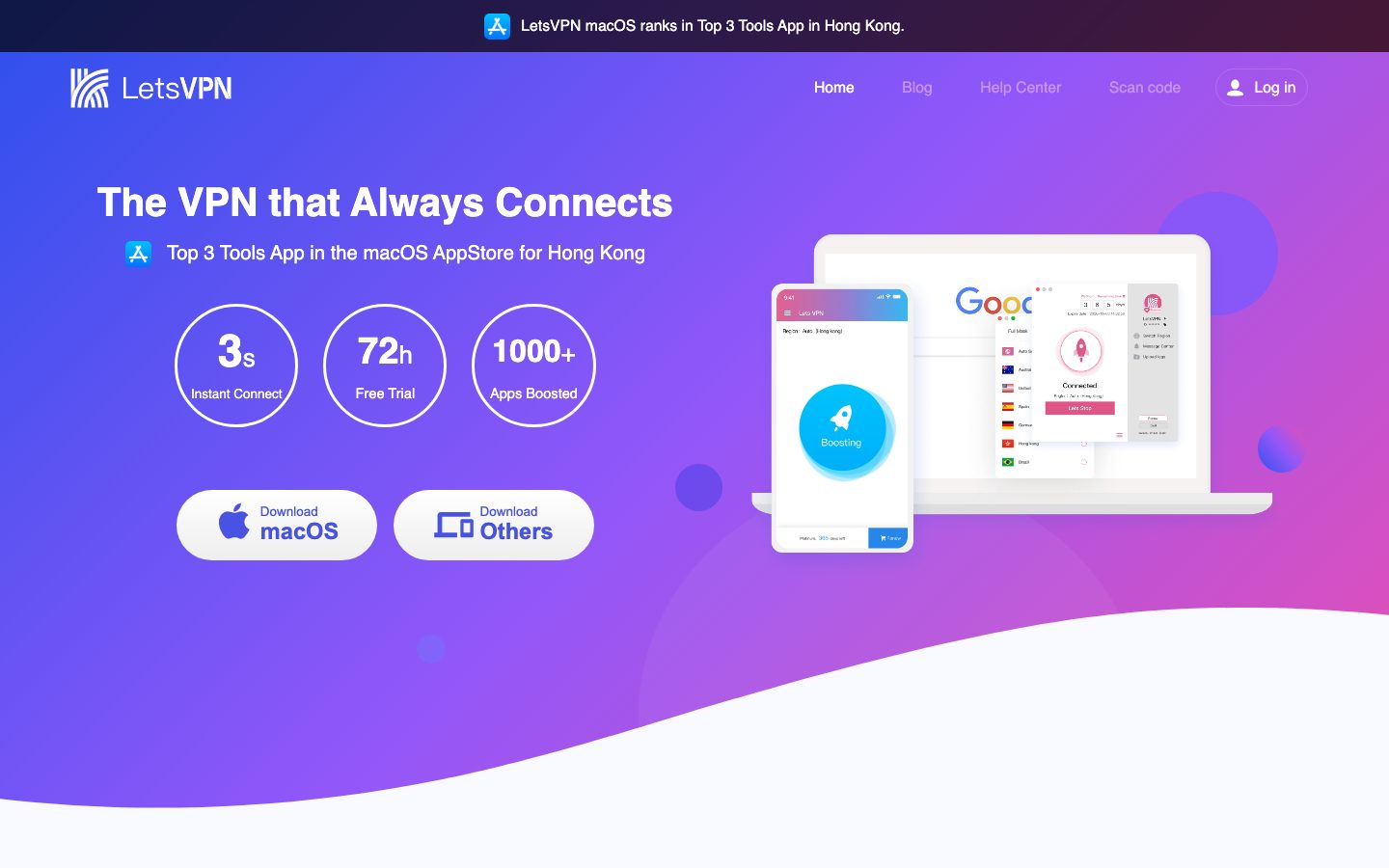
The tagline 'The VPN that Always Connects' is not backed by most real reviews. iOS users report the most reconnection attempts; Android users in Hong Kong have a better experience. Speed when connected is acceptable for streaming, but consistent connectivity is the core problem.
LetsVPN holds Google Security Review and AppEsteem certifications but has published no independent no-logs audit. Multiple reviewers describe being banned with no explanation, raising questions about what behavioral data is retained. Without a third-party audit, the no-logs claim cannot be verified.
The most consistent complaint is AI-driven account bans with no appeal path. Refund outcomes vary widely – some users receive refunds within days, others receive nothing. Support quality depends heavily on the individual agent, and there is no live chat option.
LetsVPN suits Android users outside mainland China who want a free starting tier, particularly in Hong Kong and Taiwan. New users should know: hidden pricing, a two-device cap, and – since April 2026 – no service inside mainland China. For a first VPN purchase, a provider with transparent pricing and a published audit is a safer choice.
Short answers, based on our own captures and the data on this site.
On our line it dropped from 294 Mbps to 207 Mbps on the nearest European server and 202 Mbps on a US server, with ping rising from 4 ms to 42 ms and 181 ms.
Our leak captures show no DNS or WebRTC leak while connected. Privacy also depends on the provider's logging policy and jurisdiction, which we discuss in the review above.
United Kingdom as the nearest European server and United States as the long-distance US server. Other locations may perform differently.
No. Our tests are a single controlled session; the user reviews cover months of everyday use and problems like billing, support and refunds that a speed test cannot show.
The most important fact about LetsVPN in 2026 is that it no longer serves mainland China: the company ended its mainland operations on 28 April 2026 after concluding that the network blocking could not be overcome, and its CEO confirmed in May that the service cannot be provided there any more. That removes the one use case the product was built for.
For users elsewhere, the service continues, but the long-standing problems remain – no public pricing page, a two-device limit, and real reviews that split sharply between quick connections and frustrating disconnects, refund fights and account bans. Our recommendation: mainland readers should move on entirely, and everyone else will find more transparent, more reliable options among the alternatives we link to.